


Over 200 million businesses use Facebook to reach customers, which means the competition for attention is fierce.
The chances are your biggest competitors are on Facebook, sharing posts, running ads, and engaging with your potential audiences.
If you haven’t been snooping on them, you’re missing out big time.
And since manually checking every competitor’s move can feel like stalking full-time, using a competitive analysis tool becomes your secret shortcut.
With the right tool, you can track trends, monitor campaigns, and spot opportunities without spending hours digging through pages.
Short Summary
- Competitor analysis helps you understand what’s working in your industry, so you can adjust your Facebook strategy with confidence.
- Using dedicated tools saves you time by automating tracking, reporting, and performance comparisons.
- You can uncover content gaps, audience insights, and posting trends that your competitors may be using to get ahead.
- Regular competitor analysis keeps you updated on shifts in strategy, which helps you react faster and stay competitive in a constantly changing Facebook landscape.
- Social Champ stands out for offering easy-to-use analytics, competitor tracking, and reporting, which make it one of the most effective tools for staying ahead.
This article will walk you through the best Facebook competitor analysis tools to help you spy smarter and stay one step ahead.
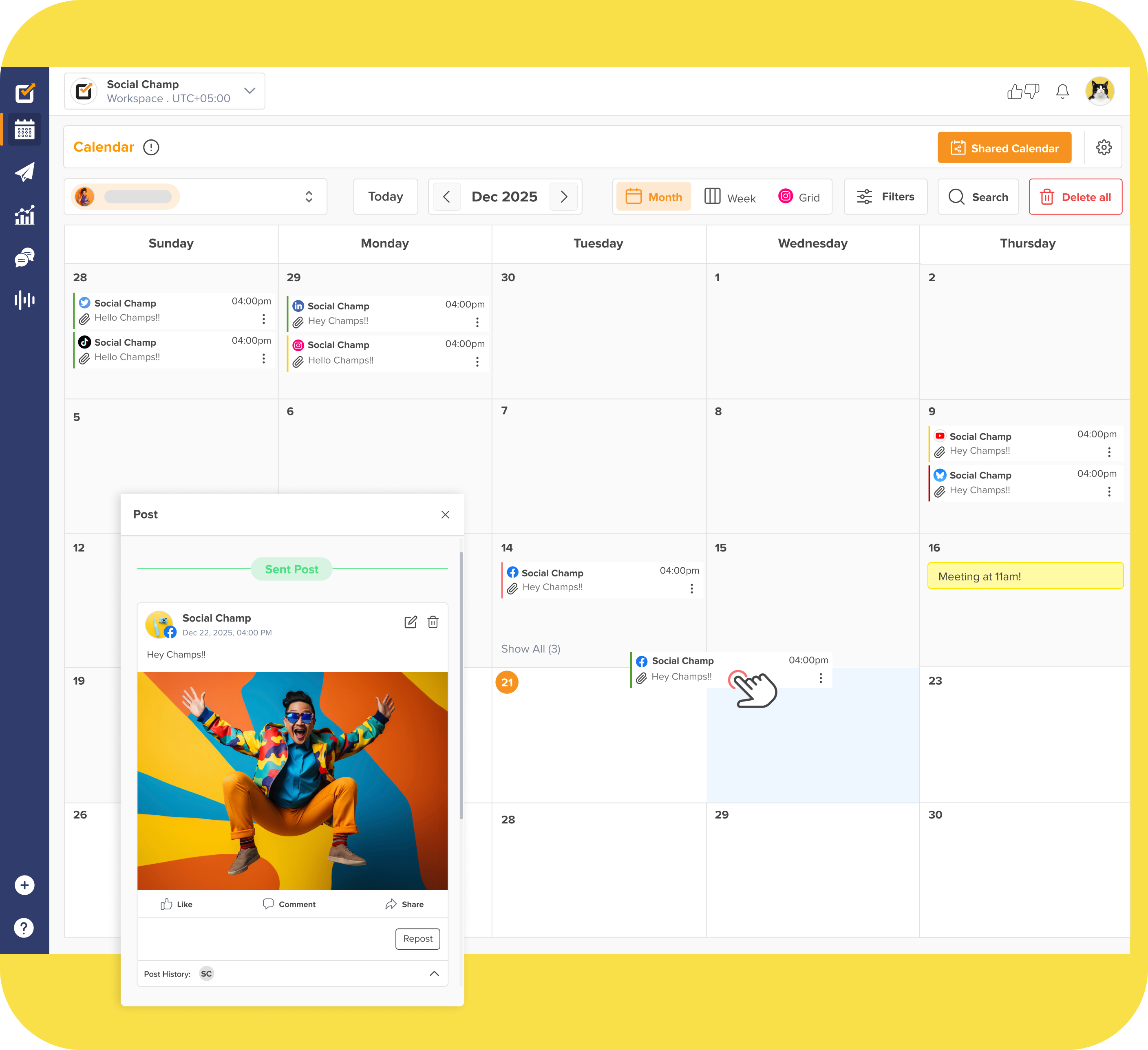
Competitive Insights at Your Fingertips
Get real-time data on your competitors, spot trends, and make smarter moves, all from one powerful dashboard.
What Is Facebook Competitor Analysis?
Facebook competitor analysis is just a fancy way of saying you’re spying on your competitors, but in a totally legal, non-creepy way.
It means checking out what other businesses like yours are doing on Facebook so you can learn what works, what flops, and how to do it even better.
When you do this, you’ll look at things like:
- Their pages
- The content they post
- How often do they post
- How many people interact with their posts
- The ads they run.
Doing Facebook page analysis is key for your social media strategy because it shows you what your audience likes, what trends are working, and where you can stand out.
Plus, it’s a lot cheaper than learning everything the hard way by trial and error.
Why Facebook Competitive Analysis is Important?
Take a look at the following benefits of social media competitive analysis that prove why it’s important:
-
Spot Market Gaps
Checking competitors can reveal topics, formats, or audiences they are missing. You get the chance to fill in those gaps and attract attention where others are ignoring it.
-
Benchmark Your Performance
Watching how your competitors perform helps you measure your own success. You can see what’s working for them and adjust your strategy so you don’t fall behind.
-
Learn What Content Resonates
Observing their posts shows what your shared audience enjoys, whether it’s videos, memes, polls, or stories. You can take inspiration and make your content more engaging, without copying their style.
-
Improve Targeting
Seeing who interacts with competitor posts gives clues about the audience most interested in your niche. You can refine your targeting so your content reaches the right people, instead of hoping random folks will notice.
-
Stay Ahead of Trends
Monitoring competitors lets you spot trends early. Viral challenges, new campaigns, or fresh content formats can inspire you to jump in before everyone else does.
How to Conduct a Facebook Competitor Analysis? (Step-by-Step Guide)
Running a Facebook competitor analysis doesn’t have to feel like detective work (though you do get to snoop around a bit).
With the right approach, you can turn all that spying into useful insights without breaking a sweat.
Here’s a simple step-by-step guide to help you understand your competitors and improve your own Facebook strategy:
Step 1: Identify Your Competitors
Start by figuring out who you’re up against, and this includes both direct and indirect competitors.
Direct competitors sell the same products or services as you, while indirect competitors target the same audience but with different offerings.
A quick Facebook page analysis or checking industry pages can give you a solid list.
Step 2: Analyze Competitor Content
Look at what kind of posts your Facebook competitors share. Are they posting videos, memes, or long articles? Are their posts fun, informative, or promotional?
Take note of what seems to resonate with their audience. You’re basically trying to figure out their secret sauce, without actually stealing the recipe.
Step 3: Track Key Metrics
Once you know your competitors, start tracking important numbers like followers, likes, comments, shares, and posting frequency. Notice what content gets the most engagement.
Once you know which competitors to watch, the next step is to start tracking their performance and engagement.
Simple tools like Facebook Insights or social media management platforms like Social Champ can help. With such a powerful tool, you can also gain insights that can enable you to know the best time to post on social media.
Step 4: Check Their Ads
Many businesses run ads on Facebook, and these can give you insight into their targeting and strategy. Check the Facebook Ad Library to see what campaigns they’re running.
Once you study their ads, you can get ideas for your own campaigns and spot opportunities they might be missing.
Step 5: Compile Your Insights
After collecting all this information, organize it in a way that’s easy to understand. You can even do a simple SWOT analysis: list strengths, weaknesses, opportunities, and threats for each competitor.
This will help you spot trends, gaps, and areas where you can do better.
Step 6: Apply What You Learn
The final step is using the insights to improve your own strategy. Post more of what your audience loves, test new content types, and refine your targeting.
Remember, social media competitor analysis isn’t just about spying; it’s about learning and staying ahead while having a little fun along the way.
Featured Article: What Is Competitive Analysis?
Top 12 Tools to Analyze Facebook Competitors Analysis
To make your work smoother and a lot less time-consuming, you need the right Facebook competitors analysis tool.
Here’s a lineup of powerful social media competitor analysis tools that can help you keep an eye on the competition and sharpen your Facebook strategy.
-
Social Champ

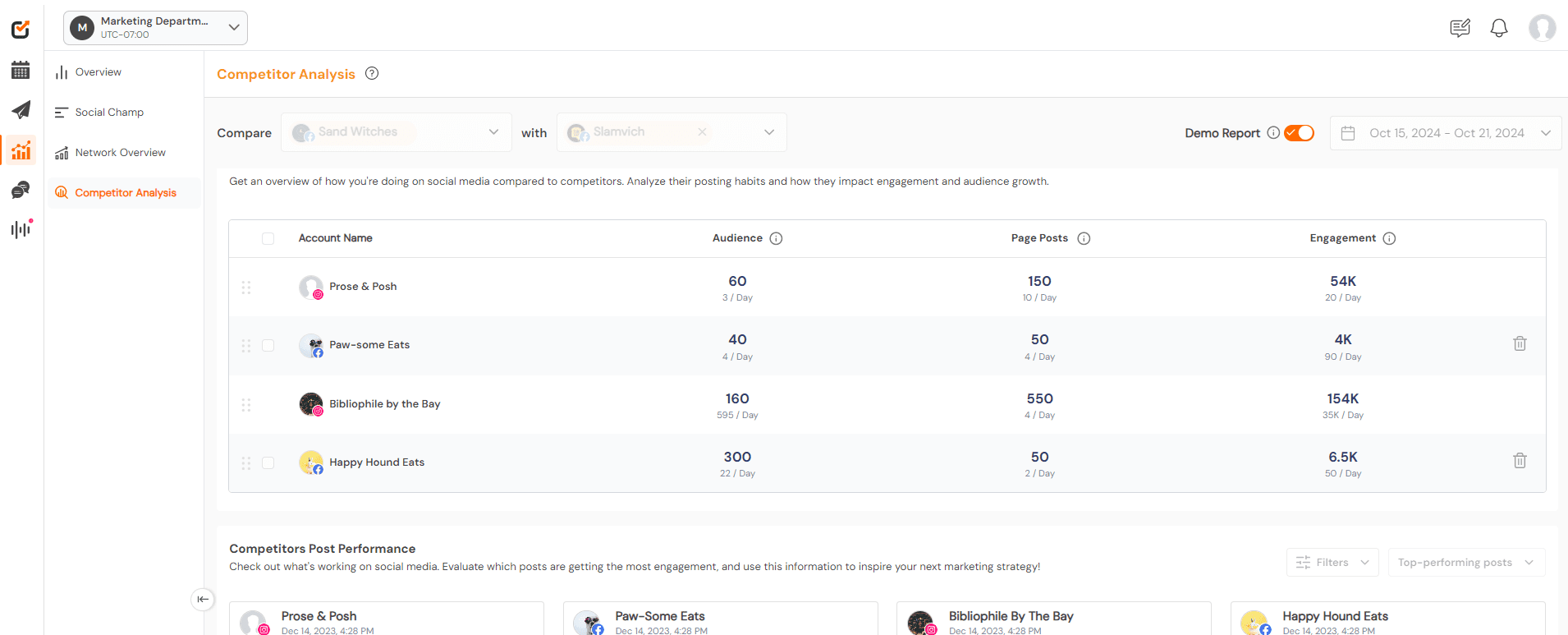
Social Champ’s Competitor Analysis Tool
Social Champ is an all-in-one social media management tool that offers competitor analysis features. With Social Champ, you can:
- Track competitor performance across Facebook and Instagram Business accounts.
- Analyze Facebook Stats and Facebook Metrics, engagement rates, and content performance, which helps you understand what resonates with your audience.
- Schedule and automate your posts based on competitor insights, ensuring maximum Facebook Engagement at optimal timing and frequency.
- Generate comprehensive reports to share with your team, facilitating data-driven decision-making based on AI-driven insights, past data, and the Facebook Algorithm.
Social Champ’s user-friendly interface and affordable pricing make it an excellent choice for businesses of all sizes. Its comprehensive feature set allows you to analyze your Facebook competitors and implement insights directly into your social media strategy.
-
BigSpy
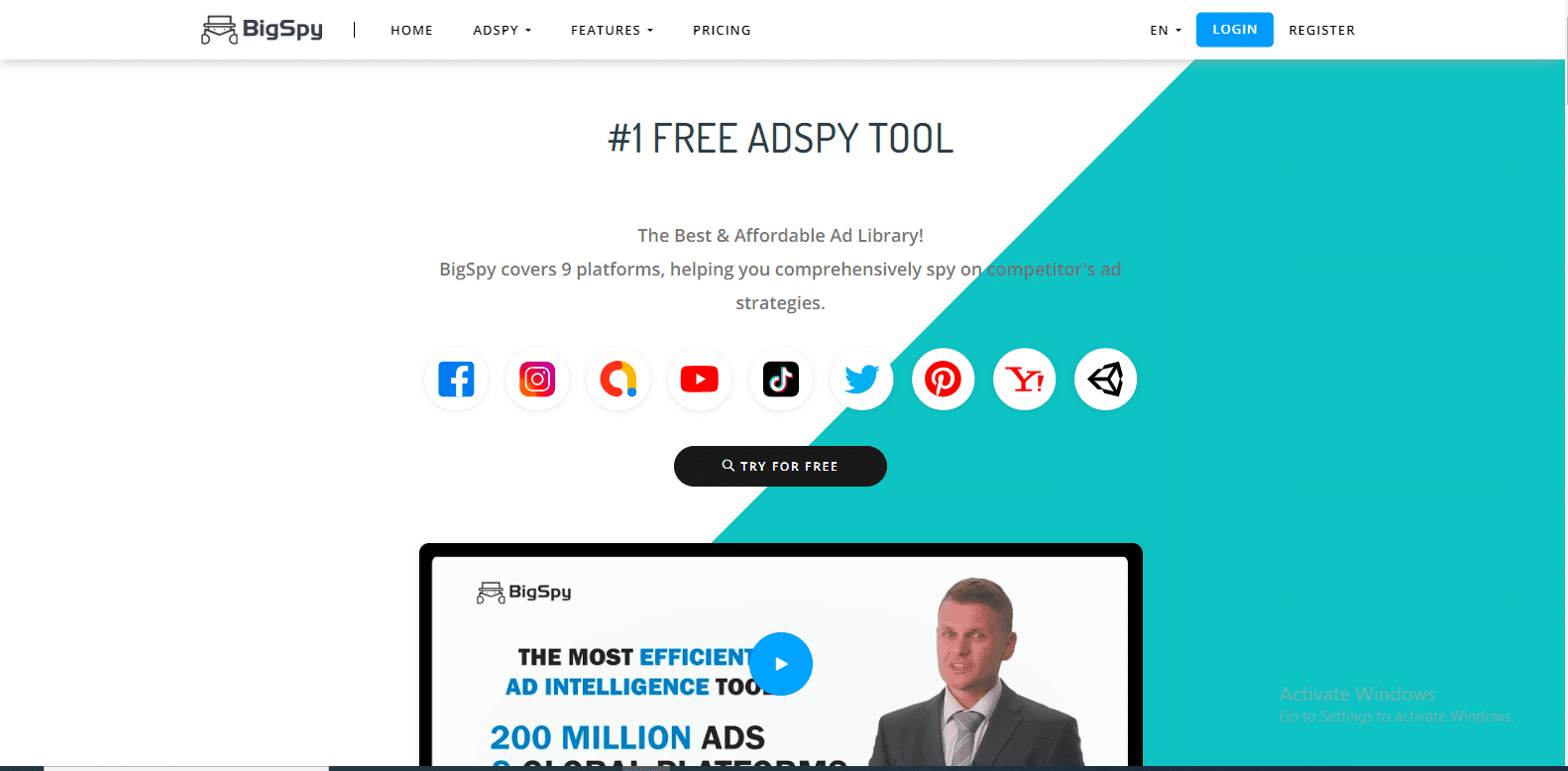
BigSpy’s Webpage BigSpy is an ad intelligence tool for competitor analysis. Its key features include:
- Extensive ad database across major platforms
- Detailed competitor ad insights
- Advanced filtering options
- Regular updates on new campaigns
- Ad saving and organization
- Engagement metrics analysis
-
Sprout Social
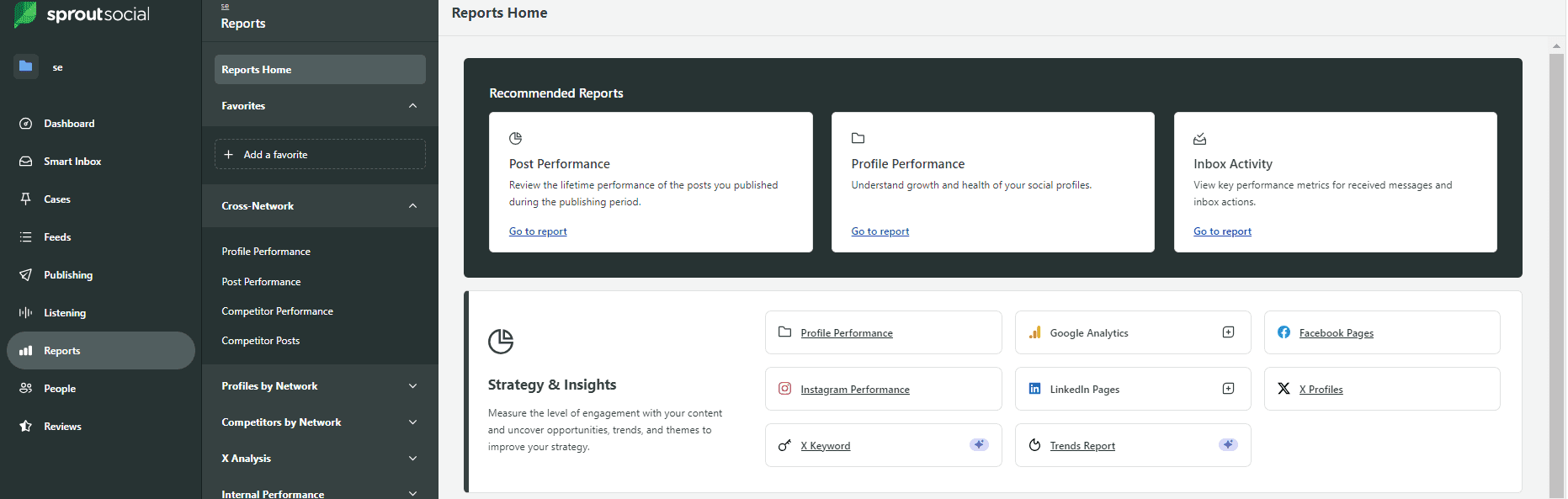
Sprout Social’s Competitor Analysis Tool Sprout Social is another social media management platform with advanced competitor analysis tools. It’s key features include:
- Monitoring competitor profiles and performance
- Analyzing engagement rates and content strategies
- Customizable reports and visualizations for performance comparison
- Advanced analytics to identify industry trends and opportunities
- Share of voice tracking for brand comparison
- Analysis of posting frequency and timing
- Monitoring competitor hashtags and keywords
Featured Article: 40 Interactive Facebook Post Ideas to Fuel Your Campaigns
-
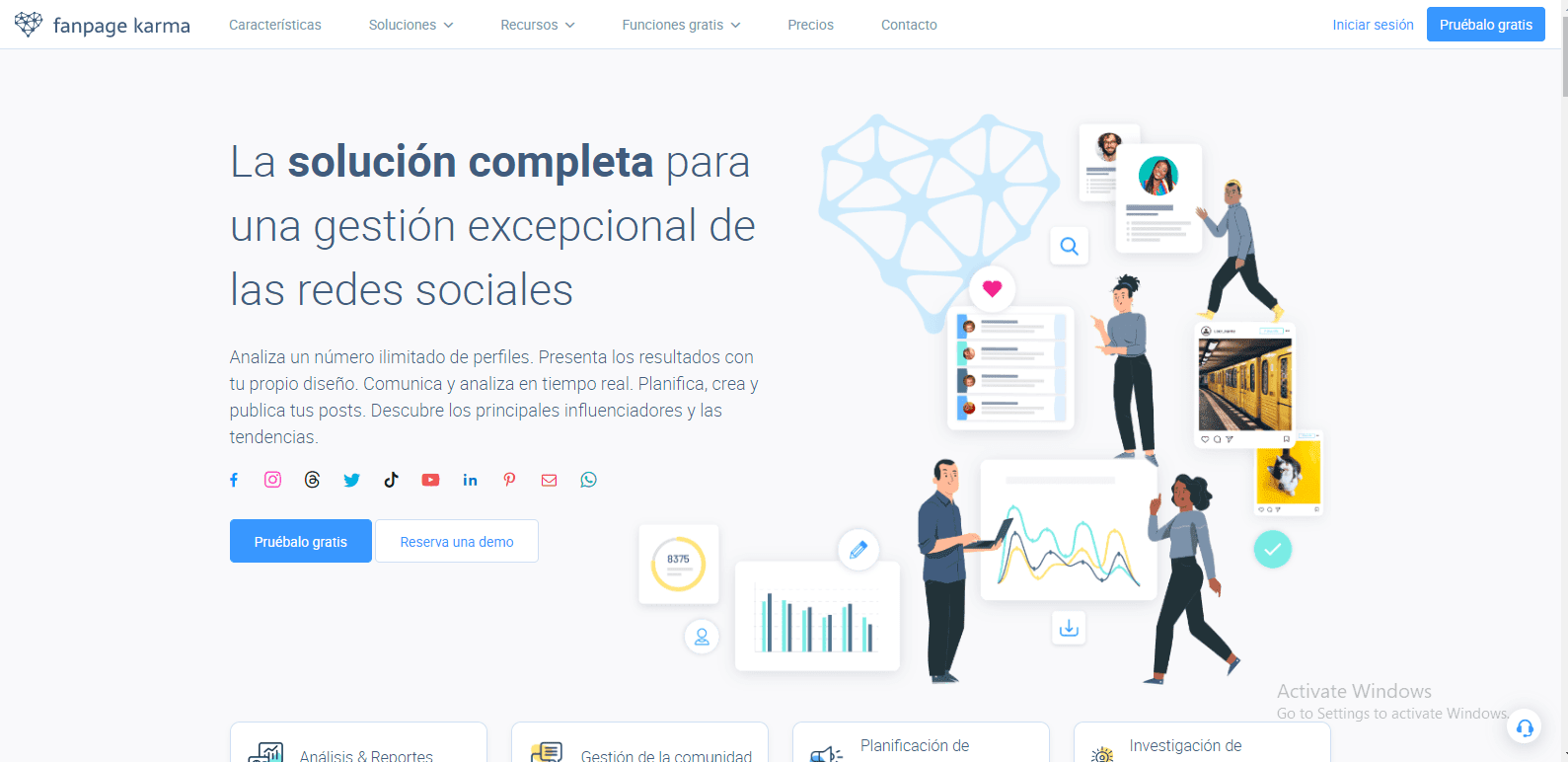
Fanpage Karma
Fanpage Karma’s Webpage Fanpage Karma is a specialized tool for Facebook and Instagram analytics with detailed competitor analysis features. Key features include:
- Tracking multiple competitors for industry benchmarking
- Analyzing post performance, engagement rates, and audience growth
- Identifying top-performing content and optimal posting times
- Generating comprehensive reports and visualizations
- Monitoring competitor advertising activities
- Analyzing follower demographics and interests
- Tracking key performance indicators (KPIs) and setting industry benchmarks
-
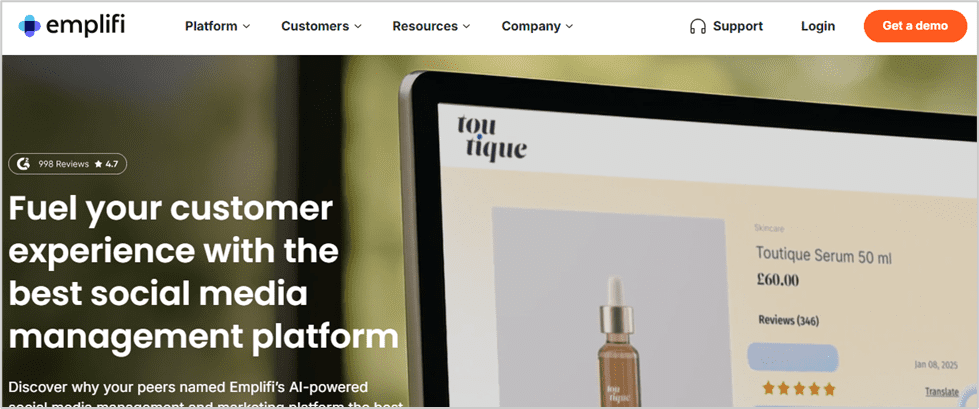
Emplify
Emplifi’s Webpage Emplifi is an enterprise-level social media marketing platform with several competitor analysis features. Key features include:
- Tracking competitor performance across Facebook, Instagram, X, and YouTube
- Analyzing content strategies and audience engagement
- Benchmarking against industry averages and top performers
- Accessing AI-powered recommendations for optimization
- Monitoring competitor ad strategies and influencer partnerships
- Generating custom reports and dashboards for stakeholders
-
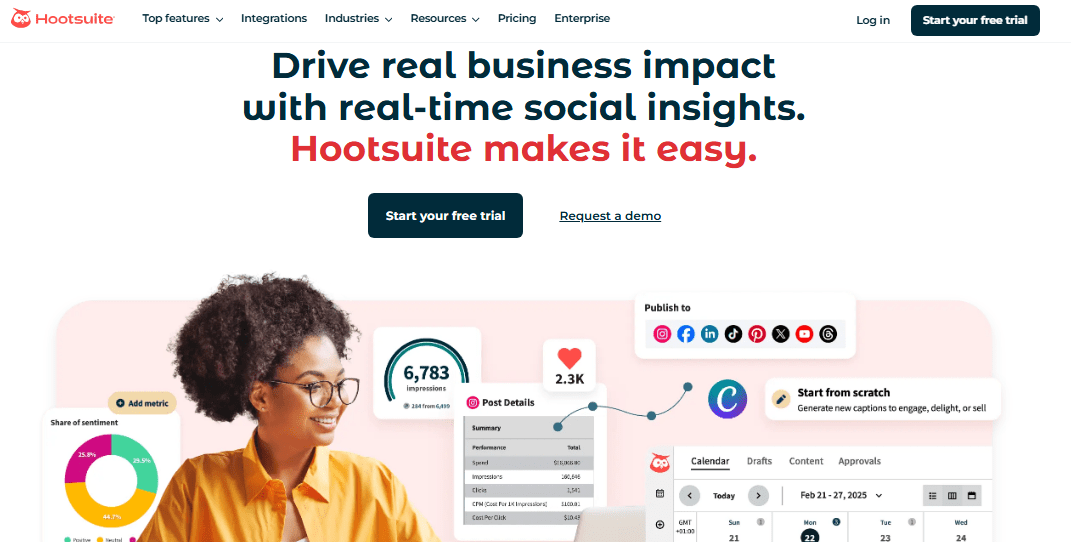
Hootsuite
Hootsuite’s Webpage Hootsuite is one of the most well-known social media management platforms, and for good reason. It gives you an easy way to keep an eye on your competitors while managing your own content all in one place.
Some of the things Hootsuite makes easy include:
- Tracking competitor performance and engagement across Facebook and multiple social platforms
- Monitoring trending posts to understand what content resonates most in your niche
- Comparing your page metrics with competitors using built-in benchmarking tools
- Viewing competitor posting patterns and audience interactions to shape your strategy
- Creating customizable analytics reports to share with your team or clients
If you want a tool that helps you understand what rival brands are doing on Facebook without jumping between countless tabs, Hootsuite earns its spot among the best Facebook analytics tools.
-
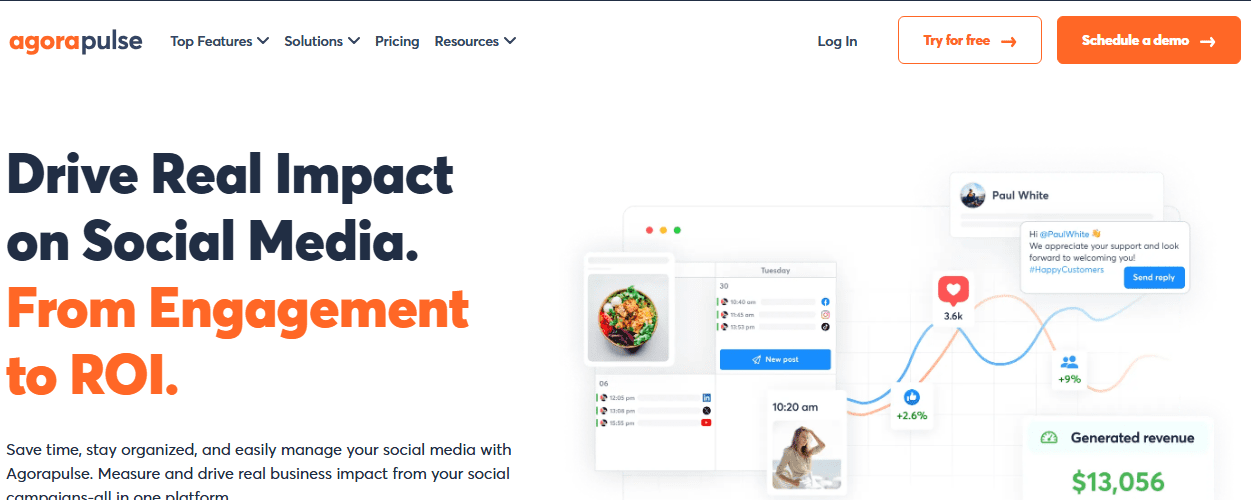
Agorapulse
Agorapulse’s Webpage If you want a Facebook competitor analysis tool that feels easy to use, this platform is definitely one to keep on your radar.
Agorapulse brings together clean visuals, smart analytics, and streamlined reporting, which make it super simple to understand how your competitors are performing and where you can outshine them.
Here’s a list of things you can get accomplished with this handy tool:
- Tracking competitors’ engagement, growth trends, and posting habits
- Comparing your Facebook performance directly against top rivals
- Monitoring hashtags, conversations, and brand mentions across social channels
- Getting automated insights on what content drives the most reactions
- Creating polished competitor reports with one-click exports
- Identifying best posting times based on real engagement patterns
Whether you’re running a brand or managing multiple clients, you’ll appreciate how straightforward and insightful Agorapulse makes competitive tracking. It saves time, cuts through the noise, and helps you stay one strategic step ahead.
-
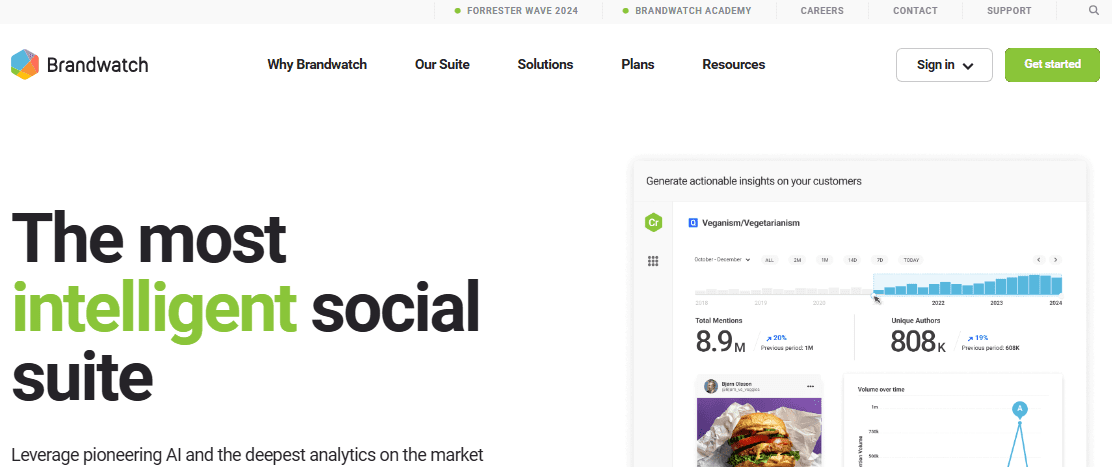
Brandwatch
Brandwatch’s Webpage When you need insights that stretch far beyond basic metrics, this tool delivers deep analytics and social listening on Facebook.
Brandwatch is built for brands that want the full picture: what competitors are posting, how audiences react, and what trends are shaping the conversation around your industry.
Its key features are:
- Tracking competitor engagement, sentiment, and content performance
- Analyzing trends, keywords, and conversations across Facebook and beyond
- Comparing brand share of voice against top competitors
- Accessing AI-driven insights to uncover patterns and opportunities
- Monitoring influencer activity and competitor partnerships
- Building advanced custom dashboards for team or client reporting
If you want a tool that helps you move from guesswork to genuinely strategic decisions, this one definitely brings the clarity you’re looking for.
-
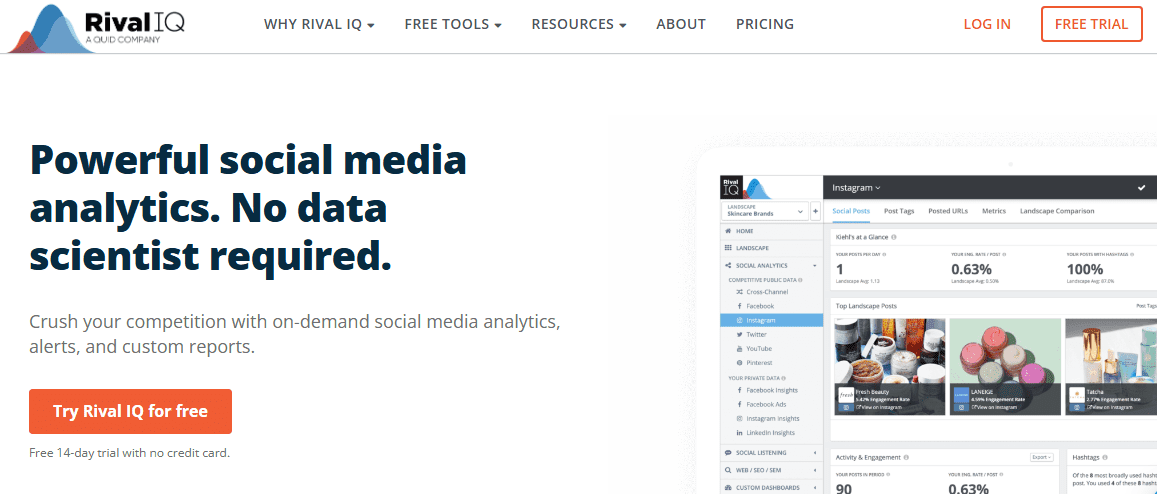
RivalIQ
RivalIQ’s Webpage Ever wished you could see exactly why your competitors’ Facebook posts are taking off while yours are just sitting there?
RivalIQ makes that possible by giving you a clear, data-backed look at what’s actually working for other brands in your space.
Here’s what you can tap into with RivalIQ:
- Breakdowns of your competitors’ top-performing Facebook content
- Engagement rate comparisons across brands, industries, and time periods
- Alerts when a competitor suddenly spikes in engagement or switches tactics
- Visual reports that make it easy to spot strengths, weaknesses, and patterns
- Hashtag, keyword, and posting frequency analysis to help you refine your strategy
This Facebook competitor’s analysis tool is a favorite among marketers because it turns competitive data into simple, actionable insights you can use right away.
-
Mention
Anyone wanting a free Facebook competitive analysis option will find Mention incredibly handy. Its recent acquisition by Agorapulse has made the platform even more powerful, combining real-time monitoring with advanced social media management features.
Once you’re inside, the platform naturally guides you into its strengths, such as:
- Real-time tracking of competitor mentions across Facebook and the wider web
- Sentiment insights that reveal how audiences genuinely feel about rival brands
- Conversation trend spotting that helps you move strategically before competitors catch on
- Side-by-side comparisons to see who’s gaining traction and who’s losing steam
- Automated reports that present insights clearly for teams and clients
Mention wraps all this up in a clean interface that feels fast, reactive, and built for marketers who don’t want blind spots.
One thing to note, however, is that the free plan restricts the number of alerts and tracking options, so you’ll need to focus on monitoring your most important competitors.
-
Social Status
Social Status’ Webpage Social Status is a handy tool for anyone looking to dig into Facebook competitor analysis. It comes with a free version that lets you get started without spending a dime.
The free plan does have fewer features than the paid version, which means the depth of insights you can gather is a bit limited. But it’s still a solid way to get a feel for your competitors’ performance.
Here’s what you can do with this Facebook competitors analysis tool:
- Monitor competitors’ engagement, growth, and posting patterns across Facebook
- Compare your page performance against rivals to see where you stand
- Track audience interactions and content trends to inform your own strategy
- Generate clear, visual reports that make it easy to share insights with your team
- Analyze multiple competitors in one dashboard for a quick, side-by-side overview
Even as one of the free competitor analysis tools, Social Status gives you a practical way to understand competitor behavior and make smarter decisions.
Upgrading unlocks deeper analytics, but for starting out, it’s a straightforward tool that keeps your Facebook strategy on track.
-
Facelift Data Studio
Facelift’s Webpage For marketers who love diving into numbers, Facelift Data Studio is a great companion for Facebook competitor analysis.
It turns raw social media data into clear, actionable insights that can help you understand what’s working for your competitors and where you can take the lead.
Here’s what to look forward to when using the tool:
- Track competitors’ engagement, growth trends, and posting habits across multiple social platforms
- Compare your Facebook performance directly against industry benchmarks
- Analyze content types, timing, and audience reactions to spot patterns
- Build customizable dashboards and reports that make data easy to digest
- Identify strengths and weaknesses across competitors to refine your own strategy
With its visual dashboards and detailed analytics, you get a clear view of your competitive landscape. This helps you make smarter decisions and stay ahead without getting lost in endless spreadsheets.


Featured Article: 15+ Competitor Research Tools
Pro Tips and Advanced Strategies to Stay Ahead on Facebook
Ready to peek behind the curtain and discover the strategies that separate the casual scrollers from the social media pros?
Let’s explore some advanced tactics that will give your Facebook strategy an edge:
-
Perform a SWOT Analysis on Competitor Data
Look at your competitors’ strengths, weaknesses, opportunities, and threats based on their Facebook activity.
This helps you see where they shine, where they falter, and how you can swoop in to grab attention. Think of it as a treasure map for your next big move.
-
Monitor Competitors’ Facebook Ads via the Ad Library
The Ad Library is like having a spyglass into your competitors’ campaigns. You can see which ads they’re running, what messaging works, and which audiences they target.
Use this insight to craft smarter campaigns without spending a fortune learning from trial and error.
-
Analyze Audience Overlap and Sentiment
See if your audience interacts with competitors’ content and how they feel about it. Positive or negative feedback can guide your own strategy and help you position your brand in a way that resonates.
-
Track Seasonal Trends in Competitor Campaigns
Notice if competitors ramp up activity around holidays, product launches, or special events. Spotting patterns lets you plan campaigns that hit at the perfect time.
Common Mistakes to Avoid in Competitor Analysis
Even the best strategies can backfire if you make some common mistakes while analyzing your Facebook competitors. Knowing what to avoid can save you time, effort, and a lot of unnecessary stress.
Let’s look at some pitfalls that can trip you up and how to sidestep them:
-
Blindly Copying Competitor Moves
Just because a competitor’s post went viral doesn’t mean the same approach will work for you. Your audience, brand voice, and goals are different.
Instead, use their successes as inspiration and adapt ideas to fit your unique strategy.
-
Ignoring Audience Differences
Your Facebook competitors may target audiences that don’t match yours. Assuming your followers will react the same way can lead to wasted effort.
Take the time to understand your own audience before implementing similar tactics.
-
Focusing Only on Vanity Metrics
Likes, shares, and followers look good on paper, but they don’t always reflect real engagement or conversions.
Keep your focus on meaningful metrics like comments, click-throughs, and leads to measure real impact.
-
Not Updating Your Analysis Regularly
Competitor strategies evolve, and old data can mislead you. Set a schedule to revisit your analysis and track changes over time.
Staying current helps you react quickly and stay ahead instead of chasing yesterday’s trends.
Turn Analytics Into Action With Social Champ
Track performance, uncover insights, and make data-driven decisions that keep you ahead of the competition
Conclusion
Facebook competitor analysis doesn’t have to be complicated or overwhelming. With the right Facebook tools, you can keep an eye on your competitors, understand what works, and discover opportunities to stand out.
Among all the options, Social Champ shines by making competitor tracking and analytics simple, actionable, and even a little fun. With it, you can monitor competitors’ pages, track engagement, analyze content, and uncover trends, all in one place.
If you want to outsmart your competition and make smarter Facebook moves, Social Champ is the tool that can give you that edge.


1 comment
Royal Sanchez
I really appreciate the focus on benchmarking content performance. How do you recommend turning competitor data into actionable strategies without copying their approach?